
Emergency Garage Door Repair Near Me: What Lakewood Homeowners Should Do First
If your garage door just snapped a cable, jumped a track, or stopped responding, the first thing to do is stop touching it. A door under spring tension can hurt you, and forcing a jammed panel usually turns a simple repair into a full track and roller replacement. Here’s the short version: assess whether the door is safe to leave where it is, disconnect the opener if it’s fighting the door, and call (866) 596-9807. We answer 24/7. Fast dispatch from 7am to 7pm, Sunday through Friday.
And if you’d rather not sort through cables and springs on your own, call us and we’ll walk you through it on the phone before a technician heads your way.
We’re Garage Door Service Lakewood, and we’ve been fixing residential garage doors since 2013. We work on LiftMaster, Chamberlain, Genie, Clopay, Amarr, Wayne Dalton, Craftsman, and Raynor. That matters in an emergency, because the right fix depends on the system you actually own, not whatever brand a one-line dealer happens to stock. Here’s how to handle the first ten minutes without making things worse.
The First Thing to Do: Assess the Door Before You Touch Anything
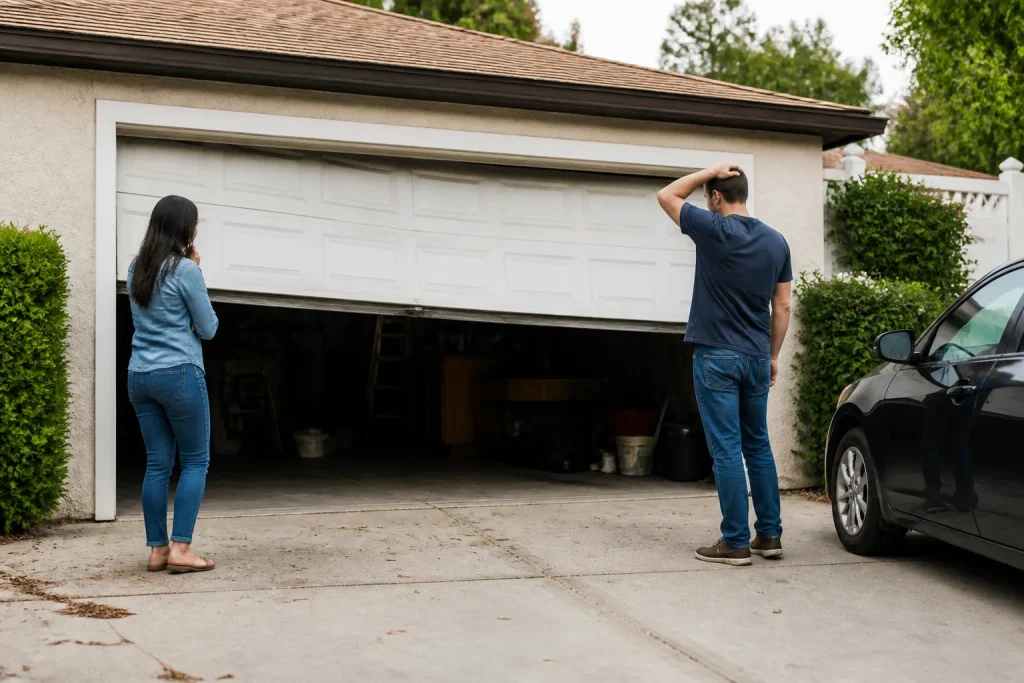
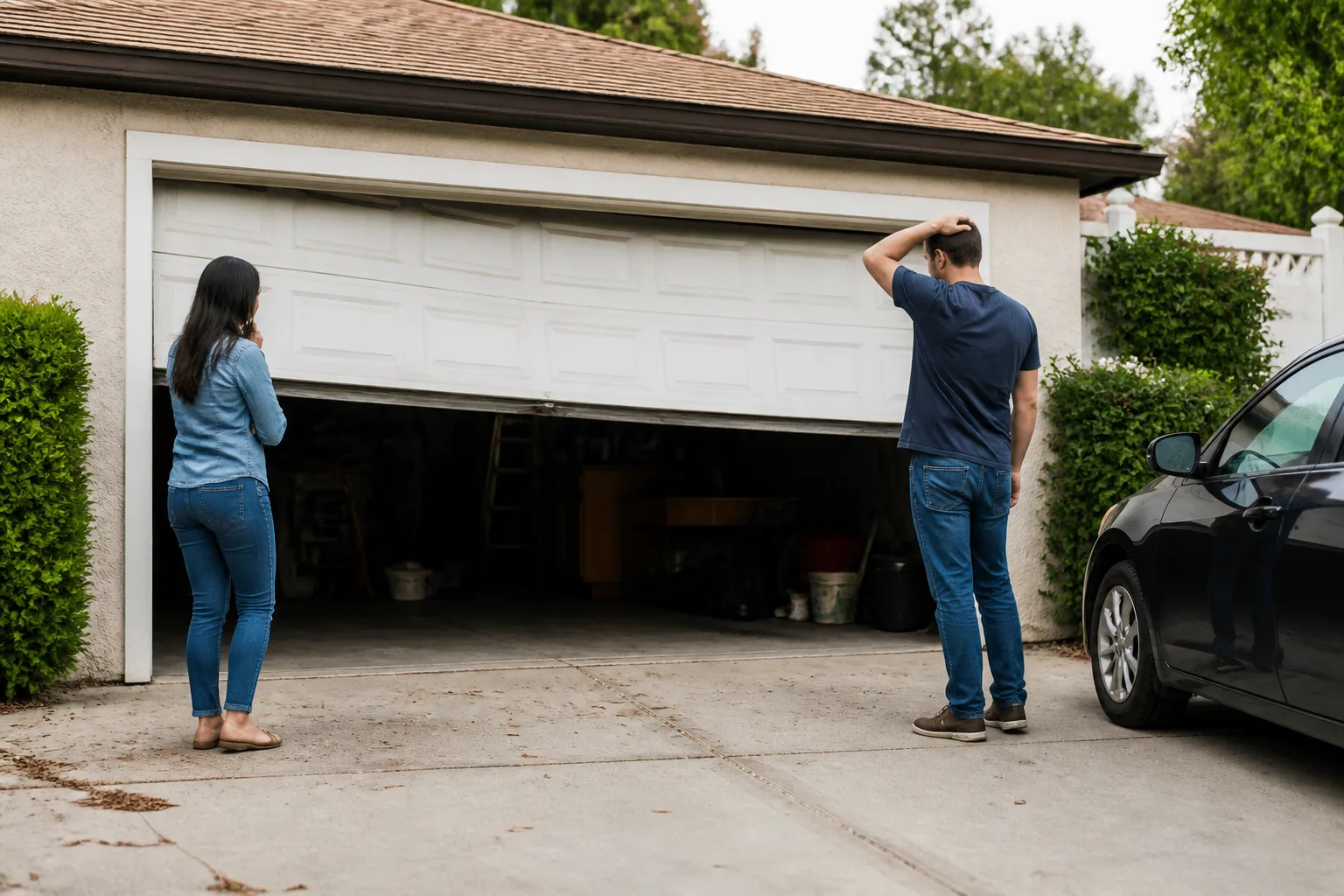
A garage door frozen mid-track with a snapped cable is under hundreds of pounds of spring tension. The most common first instinct is to yank it in one direction or hit the opener button again. Both are mistakes. Before you do anything, stand to the side of the door, not in front of it, and look at these three things:
- Is the door cocked or tilted in the opening? If one side is higher than the other, a cable has likely released or a roller has left the track. Do not operate the opener or pull the manual release yet. That sharp angle is keeping tension where it sits, and releasing it wrong can drop the panel stack.
- Are the springs still in one piece? A torsion spring runs across the header above the closed door. If you see a gap in the middle of it, the spring is broken. The door is then dead weight, and the opener motor is not built to lift it. Do not press the wall button or the remote. Leave the door wherever it is and call us.
- Is the door closed or open? A broken spring with the door down is the safest emergency scenario, because the door is already where gravity wants it. A broken cable with the door up is the riskier one, because the panel stack can fall if the remaining cable lets go. We’ll cover securing that below.
Lakewood homeowners often tell us the door “just made a noise and stopped.” That noise is usually a spring letting go or a cable snapping, and the condition of the door right after tells you how urgent the call is. If the door is closed and will not move, it’s urgent but stable. If it’s open and leaning, treat it as a hazard and keep people and cars clear of the opening.
How to Use the Emergency Release Cord Without Making a Cable or Spring Problem Worse
The red cord hanging from the opener rail is the emergency release. It disconnects the door from the opener carriage so you can operate the door by hand. But pulling it at the wrong moment, or pulling it the wrong way, can turn a jammed opener into a dropped door.
The correct pull is straight down along the track of the cord, not angled toward you or sideways. Pull once and feel for the carriage to disengage. Before you pull it, look at the door. If the door is crooked, or if you can see a loose cable hanging from a drum, do not pull the release. Disconnecting the opener when a cable is already off lets the door shift, and a shifting panel stack can drop fast. The opener is currently holding some of that tension. Leave it connected.
The release cord is meant for a door that is mostly balanced and just failed to open or close under power. If the opener motor is running but the door is not moving, that’s the classic case. The gears inside the opener may be stripped, or the carriage is stripped and spinning on the rail. Pull the release gently, then try to lift the door by hand a few inches. It should feel heavy but liftable. If it’s dead weight or will not budge, the spring is not doing its job and you’re about to lift the entire weight of the door yourself. Stop and call us.
One more piece of Lakewood-specific advice: if you disconnect the door and then close it by hand, reattach the carriage once the door is down. An open, disconnected door at night is an invitation you don’t want to send. And leave the opener unplugged until we’ve looked at it, so nobody hits the button by habit and drives the carriage into a locked door.
Specific Emergency Scenarios and the Right Response for Each
Every garage door emergency falls into one of a few patterns. Here’s what we tell Lakewood callers to do for each one, based on what we see most often across LiftMaster, Chamberlain, Genie, Craftsman, Raynor, and the other brands we service.
Snapped torsion spring: door fully down
Do not operate the opener. Do not try to lift the door by hand. A broken spring means the door weighs whatever the panels weigh, usually somewhere between 130 and 300 pounds depending on the door. The safest position is exactly where it is, down and closed. Your car may be stuck inside, and we know that’s a problem, but a technician can replace the spring and get the door balanced again. Call us and tell the person on the phone you heard a bang and the door will not open. That’s enough information for the tech to bring the right springs.
Door off track: mid-open, one side lower
Do not force it. Identify which roller has jumped by looking at the upper corners, where rollers leave the track first. If the top roller is out on one side, the panel stack is being held by the lower rollers and the remaining cable. The door can drop if you move it. If the door is blocking your only car, open the pedestrian door instead and leave the garage door alone. A technician will reset the rollers, check the track for bends, and re-tension the cables. Forcing the door down before that will bend panels and wear the roller stems.
Opener running but the door not moving
Disconnect the opener immediately with the emergency release, then unplug the opener. A stripped gear inside the motor housing is the most common cause, especially on older Chamberlain and LiftMaster chain-drive units. The motor is running but the power isn’t reaching the rail. Continuing to run it while the door stays still just chews up the remaining gear teeth and sends metal shavings through the housing. The door might be perfectly fine. This is often a garage door opener repair, not a door repair, and we handle both on the same visit.
Door stuck open with a broken cable
This is the one that needs security attention before anything else. If a cable has snapped and the door is up, the panel stack is hanging on one good cable. You’ll often see the door sitting slightly crooked. Do not stand under it. Do not put anything valuable or park a car under it. To secure the opening temporarily, run a heavy-duty ratchet strap through the bottom corner brackets of the door and anchor it to a solid point, like a lag bolt in the wall framing or a vehicle tow point if nothing else is available. The goal is not to pull the door down, but to create a secondary hold if the remaining cable lets go. If you have no strap, a length of chain and a lock through the track a foot above a roller will at least block the path. And if you have a second car inside, move it out of the garage if you can do so safely.
What Legitimate Emergency Service Actually Includes, and What Gets Upsold
Here’s the part most garage door articles skip. An emergency callout is the technician coming to get your door safe and secure, diagnosing the failure, and doing the repair if the parts are on the truck. It is not an instant everything-is-new quote. Companies that pitch you a full new door within five minutes of arriving, before they’ve even checked the tracks and the spring balance, are selling under pressure. You deserve better.
In Lakewood, a legitimate emergency call should sound like this: the technician secures the door, identifies the failed component, shows you what broke and why, and gives you a written price before any work starts. The estimate is free. If the repair is a spring, roller, hinge, or sensor, the work often happens right then, with parts from the truck. If the panel is too damaged to repair, or the opener is beyond its service life, you should hear that as an honest recommendation, not a hard pitch before lunch.
We work on your brand. That’s the honest answer to whether you should call a LiftMaster dealer, a Genie dealer, or a general handyman. We carry parts for eight major brands, including LiftMaster, Chamberlain, Clopay, Amarr, Wayne Dalton, Craftsman, Raynor, and Genie, so the tech who shows up is already familiar with your system. You’re not paying us to learn the brand in your driveway. That’s the difference between a real emergency response and a next-morning appointment being sold as urgent.
What happens when you call
- 1
A real person answersNo phone trees – you reach a local pro.
- 2
You get an upfront price rangeHonest numbers before anyone is dispatched.
- 3
A background-checked tech heads outLicensed & insured, dispatched right away.
- 4
You approve before work beginsNothing starts until you say go.
When to Call a Pro, and What You Can Safely Check Yourself
There are a few things worth checking before you call, but only if the door is already closed and not under visible stress. Check the safety sensors near the bottom of the track on both sides. When they’re misaligned, the opener will close partway and reverse, or refuse to close at all. Check the wall button and the remote batteries if the door won’t respond to any button. These are homeowner-level checks. But anything involving springs, cables, or a door that’s leaning belongs with a technician.
Garage door springs are the one component we never recommend a homeowner replace as a DIY job. A torsion spring holds a massive amount of stored energy, enough to break a wrist or worse if it releases while you’re winding it. Extension springs can become projectiles if a cable slips. The job looks simple in videos, but the penalty for a wrong move is severe. If your door has a spring issue, call a company that carries your brand’s spring sizes and has the correct winding bars. That’s us. It’s garage door repair, and it’s the most common emergency we run.
The Bottom Line
Here are the key takeaways for a garage door emergency in Lakewood:
- Stop operating the door the moment it behaves strangely. A second attempt with a broken spring or a jammed panel causes more damage.
- Assess the position. A broken spring with the door down is stable. An open, leaning door is not. Treat the leaning door as a falling hazard and secure the area.
- Use the emergency release only when the door is balanced and the opener is failing. Pull straight down, and never disconnect a door that’s already off track or showing a loose cable.
- Secure a stuck-open door temporarily with a ratchet strap or chain so a broken cable doesn’t become a dropped door overnight.
- Call a company that knows your brand. The right parts on the truck is the difference between a one-visit fix and a two-visit headache.
If you’re in Lakewood and need help, Garage Door Service Lakewood offers free estimates. Call (866) 596-9807. We answer 24/7. Fast dispatch from 7am to 7pm, Sunday through Friday. We’ll tell you what’s wrong, what it costs, and whether the door should be repaired or replaced, with no pressure either way.
Frequently Asked Questions
Yes. We dispatch fast from 7am to 7pm, Sunday through Friday, and most Lakewood callers get a technician out the same day they call. Phone lines are answered 24/7 so you can reach a person at any hour, and a call outside dispatch hours is booked into the next opening. Call (866) 596-9807 and tell us what the door is doing. We’ll tell you what’s safe to leave until we arrive.
Every job is priced by the written estimate, and the estimate is free. A single broken spring, a snapped cable, or a roller reset each carries a different parts and labor cost, and the final number depends on your door’s size, brand, and hardware. You’ll get a specific price on paper or on your phone before any work begins. Call (866) 596-9807 for an exact quote.
If the door is closed and will not open, it’s usually fine to leave it overnight. A closed door is secure and stable, even with a broken spring, as long as nobody tries to operate it. If the door is stuck open, treat that as a security and safety issue: secure the panel stack with a strap or block the track, remove valuables, and call us. We’ll get someone out as soon as the dispatch window reopens.
We work on eight major residential brands: LiftMaster, Chamberlain, Genie, Clopay, Amarr, Wayne Dalton, Craftsman, and Raynor. That covers most doors and openers in Lakewood homes. If you have a Chamberlain opener that won’t respond, a Clopay panel that cracked, or a Wayne Dalton spring that snapped, we’ve seen it before and we carry the parts. For garage door opener repair or a full door issue, one visit covers the whole system.
For more about our service area and coverage in your neighborhood, see Lakewood. If you’re deciding between fixing and replacing a door, the answer comes down to the condition of the panels and the rails, not a sales pitch, and we’ll show you both numbers before you commit.
Written by the team at Garage Door Service Lakewood, serving Lakewood since 2013.
Need Garage Door Help?
Call Garage Door Service Lakewood - licensed & insured, here with fast help in Lakewood.
(866) 596-9807